If you’ve recently started researching flight training, you’ve probably come across the term controlled airspace. While it may sound intimidating at first, controlled airspace is simply an organized system designed to help pilots and air traffic controllers keep the skies safe and efficient.
Whether you’re pursuing aviation as a career or flying for recreation, understanding controlled airspace is one of the foundational concepts you’ll learn during flight training. It affects where you fly, who you communicate with, and how aircraft safely operate alongside one another every day.
Let’s break down what controlled airspace is, how it works, and why learning to operate within it is such an important part of becoming a confident pilot.
What Is Controlled Airspace?
Controlled airspace is any area of airspace where air traffic control (ATC) provides services to aircraft operating within that designated area. Depending on the type of airspace and the conditions, those services may include providing clearances, issuing traffic advisories, sequencing arriving and departing aircraft, or separating aircraft from one another.
The purpose of controlled airspace is straightforward: to create a safe, organized environment where many aircraft can operate efficiently at the same time.
Contrary to what many people assume, controlled airspace doesn’t mean pilots are constantly being directed every second they’re in the air. Instead, it establishes standardized procedures that allow pilots and air traffic controllers to work together to maintain safe operations.
As a student pilot, you’ll quickly become familiar with these procedures through classroom instruction, simulator training, and real-world flight experience.
Why Does Controlled Airspace Exist?
Imagine hundreds of vehicles driving through a busy intersection without traffic lights, stop signs, or lanes. It wouldn’t take long for confusion—and accidents—to occur.
The same principle applies in aviation.
Every day, thousands of aircraft ranging from small training airplanes to commercial airliners, military aircraft, helicopters, and business jets share the same skies. Controlled airspace creates structure that allows all of these aircraft to operate safely while minimizing delays and reducing the risk of conflicts.
Air traffic controllers help manage aircraft by providing instructions, coordinating arrivals and departures, and ensuring pilots maintain safe spacing when necessary.
This organized system allows airports of all sizes to handle a high volume of traffic efficiently while maintaining an exceptional level of safety.
The Different Types of Controlled Airspace
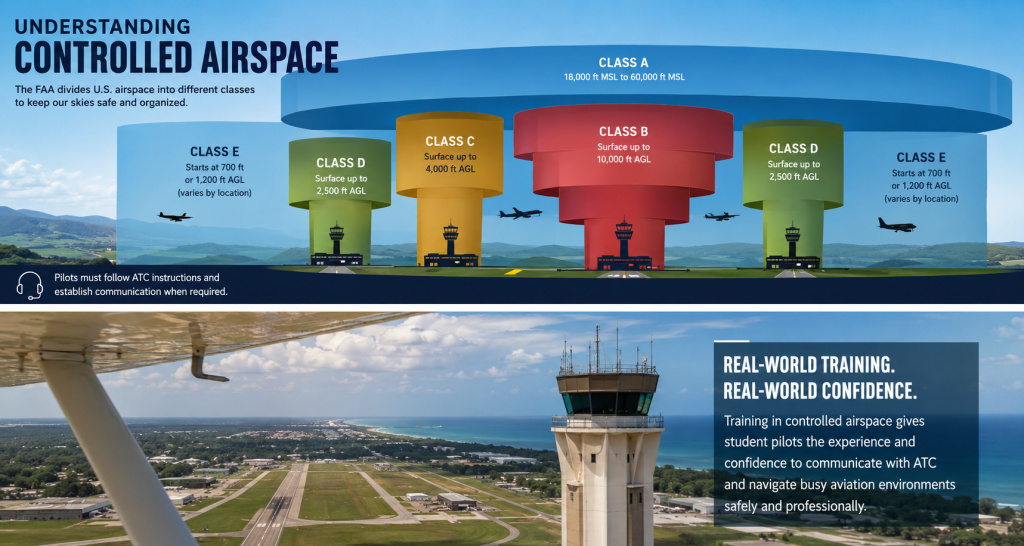
In the United States, the Federal Aviation Administration (FAA) divides airspace into several different classifications. Each type serves a different purpose based on the amount of air traffic and the complexity of operations in that area.
Class A Airspace
Class A airspace covers the nation’s busiest high-altitude airways and generally extends from 18,000 feet mean sea level (MSL) up to 60,000 feet MSL.
This is where the majority of commercial airline traffic operates during cruise flight. All aircraft flying in Class A airspace operate under Instrument Flight Rules (IFR) and are under the positive control of air traffic control.
Most student pilots won’t fly in Class A airspace during primary training, but understanding its purpose helps illustrate how aviation is organized at every altitude.
Class B Airspace
Class B airspace surrounds the busiest airports in the country, such as those serving major metropolitan areas.
Because these airports experience extremely high traffic volumes, Class B airspace is carefully designed to manage aircraft arriving and departing from multiple directions.
Pilots must receive explicit clearance from air traffic control before entering Class B airspace. Communication and situational awareness are especially important in these environments.
Class C Airspace
Class C airspace typically surrounds airports with a moderate amount of commercial and general aviation traffic.
Pilots are required to establish two-way radio communication with air traffic control before entering Class C airspace. Controllers provide sequencing and traffic advisories to help aircraft operate safely around the airport.
Many student pilots gain valuable experience flying in or near Class C airports as they advance in their training.
Class D Airspace
Class D airspace surrounds airports with an operating control tower but generally less traffic than Class B or Class C airports.
Student pilots frequently train at Class D airports because they provide an excellent learning environment. Paris Air operates in Vero Beach Regional Airport, a Class D airpace, giving pilots the opportunity to practice communicating with ATC while being a manageable environment for those developing their skills.
Learning to confidently communicate with ATC in Class D airspace helps prepare students for more complex flying environments later in their aviation careers.
Class E Airspace
Class E airspace makes up much of the controlled airspace across the United States. It often begins at either 700 feet or 1,200 feet above ground level, depending on the location, and extends upward until Class A airspace begins.
Although there may not always be an active control tower nearby, Class E airspace still supports IFR operations and provides an organized structure for aircraft operating under a variety of conditions.
Many cross-country flights spend a significant amount of time operating within Class E airspace.
Controlled Airspace vs. Uncontrolled Airspace
One of the most common questions new pilots ask is how controlled airspace differs from uncontrolled airspace.
In controlled airspace, pilots communicate with air traffic control whenever required by the airspace classification. Controllers help organize aircraft movement and provide additional services that enhance safety and efficiency.
In uncontrolled airspace, there is no air traffic control service actively directing aircraft traffic. Instead, pilots are responsible for maintaining safe separation through visual scanning, following standard traffic patterns, and making position reports over a common traffic advisory frequency (CTAF).
It’s important to remember that “uncontrolled” does not mean unregulated or unsafe. Pilots operating in uncontrolled airspace still follow FAA regulations, established traffic patterns, and standardized communication procedures to ensure safe operations.
Both controlled and uncontrolled environments require professionalism, situational awareness, and sound decision-making.
Why Learning Controlled Airspace Matters
Understanding controlled airspace isn’t simply about passing a written exam. It’s about becoming a safer, more confident pilot.
As students gain experience communicating with air traffic control, they begin developing skills they’ll use throughout their aviation careers. These include:
- Clear and concise radio communication
- Listening and responding accurately to ATC instructions
- Maintaining situational awareness
- Understanding aircraft sequencing
- Navigating busy traffic environments
- Building confidence under increasing workload
At first, radio communications may seem fast-paced or even overwhelming. However, with consistent practice, these exchanges quickly become second nature.
Most experienced pilots will tell you that one of the biggest confidence boosters during training is realizing that talking to air traffic control becomes just another part of every flight.
How Student Pilots Learn to Operate in Controlled Airspace
Flight training introduces controlled airspace gradually.
Students typically begin by learning the fundamentals of radio phraseology and airport operations during ground school. Instructors explain when communication with ATC is required, how to request taxi clearance, how to acknowledge instructions, and what to expect during different phases of flight.
As students progress into the cockpit, instructors guide them through real radio communications while allowing them to build confidence one transmission at a time.
With every lesson, students become more comfortable managing aircraft control while communicating effectively with controllers.
This step-by-step approach transforms what initially feels intimidating into a routine part of every flight.
Training in a Real-World Environment
One of the advantages of training in controlled airspace is that students experience the same procedures used by professional pilots every day.
Rather than waiting until advanced ratings to develop communication skills, students begin building these habits early. This creates confidence, reinforces professionalism, and prepares pilots for increasingly complex flight operations.
At Paris Air, students regularly gain experience communicating with air traffic control while operating in an active aviation environment. Working alongside experienced instructors allows students to develop strong radio communication skills, understand standard operating procedures, and become comfortable navigating real-world traffic scenarios.
These experiences help bridge the gap between classroom knowledge and practical application, giving students valuable exposure to the environments they’ll encounter throughout their aviation careers.
Controlled airspace plays a vital role in keeping aviation organized, efficient, and safe. While it may seem complex when you’re first learning to fly, understanding how controlled airspace works is one of the most rewarding milestones in flight training.
As your knowledge grows and your confidence builds, communicating with air traffic control becomes a natural part of every flight. The procedures that once seemed intimidating eventually become routine, allowing you to focus on what matters most—flying the aircraft safely and professionally.
Whether your goal is to fly recreationally or pursue a career with an airline, mastering controlled airspace is an essential step toward becoming a skilled, confident pilot. With quality instruction, consistent practice, and real-world experience, you’ll develop the knowledge and communication skills needed to navigate the skies with confidence.
Looking to learn more about controlled airspace? Paris Air is releasing a new educational series called “Paris Air Explains.” Follow us on Instagram, TikTok or YouTube to catch these episodes.
Ready to fly with us? Apply today!